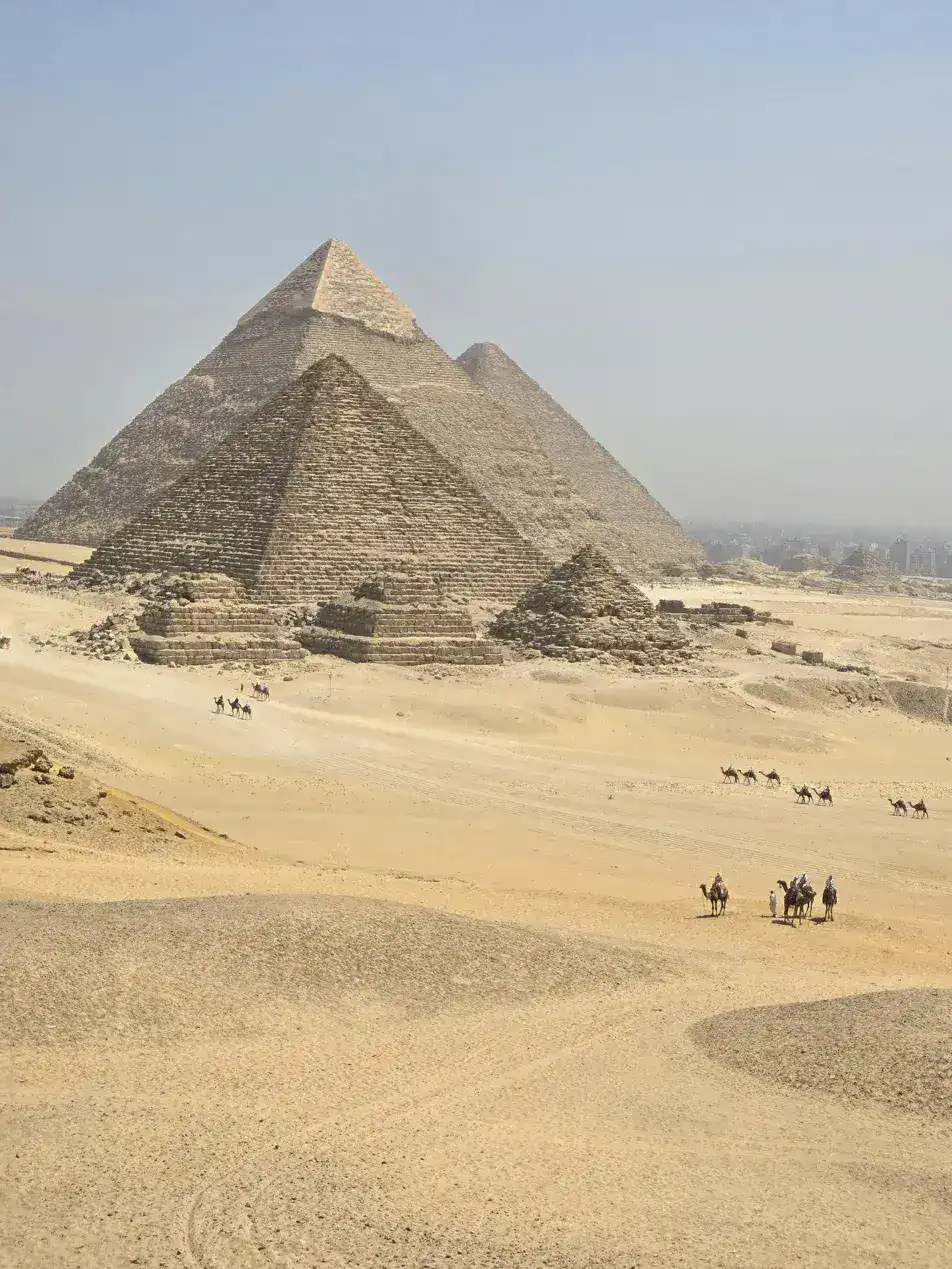
Cairo, Egypt
Egypt's Eternal Capital — Where the Pyramids Meet a City of a Thousand Minarets
Best Time to Visit
October to March
Region
Cairo & Giza
Recommended Duration
4-6 days
Difficulty
Easy
Discover Cairo, Egypt
Cairo is the greatest city in the Arab world — a metropolis of 22 million built where the last surviving Wonder of the Ancient World rises from the desert's edge and a thousand medieval minarets pierce the sky above the Nile. At Giza, the Pyramids and Great Sphinx have defied time for 4,500 years. The Grand Egyptian Museum houses Tutankhamun's complete treasures for the first time in history. Islamic Cairo preserves one of the world's finest medieval urban landscapes — the Citadel, Sultan Hassan Mosque, and the luminous spine of Al-Muizz Street. In Coptic Cairo, the Hanging Church and ancient fortress of Babylon form Christianity's oldest living sacred quarter. Cairo rewards every traveler who surrenders to its scale, its beauty, and its five thousand years of unbroken human story.
Cairo, Egypt Highlights
Explore the treasures that make Cairo, Egypt one of Egypt's most captivating destinations.
Giza Pyramids & Great Sphinx
The Giza Pyramids are the last surviving Wonder of the Ancient World — three colossal royal tombs rising from the desert plateau on Cairo's western edge, built with precision and ambition that defies explanation after 4,500 years. The Great Pyramid of Khufu was the tallest structure on Earth for nearly 4,000 years. Beside them, the Great Sphinx gazes eternally eastward across the desert. No photograph prepares a visitor for the overwhelming reality of standing before these monuments — humanity's greatest achievement in stone.
Grand Egyptian Museum (GEM)
The Grand Egyptian Museum is the largest archaeological museum on Earth — a breathtaking institution built at the foot of the Giza Pyramids housing over 100,000 ancient objects, including Tutankhamun's complete tomb treasures displayed together for the first time in history. Its soaring atrium, dominated by a colossal standing statue of Ramesses II, sets the tone for an encounter with one of history's greatest civilizations. For any traveler visiting Egypt, the GEM is not just a museum — it is essential.
Egyptian Museum (Tahrir)
For over a century, the Egyptian Museum on Tahrir Square has guarded Egypt's most extraordinary ancient treasures — over 120,000 artifacts housed in a beautiful Belle Époque building in the heart of Cairo. Royal mummies, painted coffins, colossal statuary, and everyday objects from 5,000 years of civilization fill corridor after corridor in an atmosphere of layered, accumulated history that no modern museum can replicate. For travelers who love archaeology and the romance of discovery, the old museum remains an essential Cairo experience.
Saqqara & Step Pyramid
Saqqara is where Egyptian civilization took its most audacious architectural leap — home to the Step Pyramid of Djoser, built around 2650 BC and recognized as the world's oldest monumental stone structure. Rising in six great steps above the desert plateau, it was the prototype for every pyramid that followed. The beautifully restored funerary complex surrounding it gives visitors an intimate, uncrowded encounter with the very dawn of monumental architecture. The surrounding necropolis, with its painted Old Kingdom mastaba tombs, adds extraordinary ancient depth.
Memphis (Mit Rahina)
Memphis was the first capital of unified Egypt — founded around 3100 BC and one of the greatest cities of the ancient world for over 3,000 years. Today the open-air museum at Mit Rahina preserves several extraordinary monuments including a breathtaking colossal recumbent statue of Ramesses II, an exceptional alabaster sphinx, and architectural fragments hinting at the vanished grandeur of what was once the most important city on Earth. A deeply atmospheric and often uncrowded complement to the Saqqara pyramids nearby.
Dahshur Pyramids
Dahshur is one of Egypt's most rewarding and least-visited ancient sites — a desert necropolis containing two of the most historically important pyramids ever built. The Bent Pyramid, whose angle changes dramatically midway, and the Red Pyramid — Egypt's first true smooth-sided pyramid and direct ancestor of the Great Pyramid — represent the critical experimental phase of pyramid construction under Pharaoh Sneferu. Visitors can enter the Red Pyramid's burial chambers via a long descending passage — one of the most accessible and atmospheric pyramid interiors in Egypt, almost always uncrowded.
Citadel of Saladin
The Citadel of Saladin is Cairo's most dramatic historic landmark — a massive medieval fortress built in 1176 crowning a rocky spur above the city, serving as the seat of Egyptian government for nearly 700 consecutive years. From its battlements, the entire panorama of Cairo spreads below — minarets, domes, and the distant Pyramids on the western horizon. Inside the walls, the magnificent Mohamed Ali Mosque dominates the skyline, while several excellent museums occupy the fortress's historic buildings. An unmissable introduction to Islamic Cairo.
Mohamed Ali Mosque
The Mosque of Mohamed Ali — known as the Alabaster Mosque for the pale Egyptian alabaster lining its interior — is the most visually commanding Islamic monument in Cairo, its paired Ottoman domes and soaring pencil minarets dominating the city's skyline from within the Citadel. Built between 1830 and 1848, its interior is a breathtaking space of light, marble, and hanging chandeliers. The elevated courtyard offers some of the finest panoramic views of Cairo from any single point in the city — Pyramids, Nile, and endless rooftops stretching to the horizon.
Sultan Hassan Mosque
The Mosque-Madrasa of Sultan Hassan, built between 1356 and 1363, is widely regarded as the greatest monument of Mamluk Islamic architecture in the world. Its entrance portal — at 38 meters the tallest in Islamic architecture — creates an approach of pure theatrical drama. The interior courtyard, with its soaring vaulted iwans and intricately carved stone surfaces, achieves a quality of austere, monumental beauty that few religious buildings anywhere can match. For travelers with an appreciation of architecture at its most ambitious, Sultan Hassan is one of Cairo's defining experiences.
Al-Rifai Mosque
Standing directly opposite Sultan Hassan, the Al-Rifai Mosque is Cairo's royal mausoleum — the burial place of Egypt's Khedival and royal families, including King Farouk and Mohammad Reza Shah Pahlavi of Iran. Completed in 1912, its soaring interior with vast central dome, marble floors, and ornate decoration creates an atmosphere of imperial grandeur appropriate to its role as Egypt's royal burial place. The architectural dialogue between Al-Rifai and Sultan Hassan across the great square is one of the most magnificent urban compositions in Islamic Cairo.
Khan el-Khalili Bazaar
Khan el-Khalili is one of the oldest and most atmospheric bazaars in the Arab world — a vast medieval marketplace trading continuously since 1382, its labyrinthine lanes packed with goldsmiths, spice merchants, perfumers, and antique dealers in a sensory explosion of color, sound, and fragrance. Beyond the tourist shops along the main lanes, deeper alleys reveal a living, working marketplace where Cairenes have bought and sold for six centuries. For luxury travelers seeking the authentic pulse of Islamic Cairo at its most vivid and most human, Khan el-Khalili is unmissable.
Al-Muizz Street
Al-Muizz Street is the most important historic thoroughfare in Islamic Cairo — a medieval street whose two-kilometer length is lined with the highest concentration of medieval Islamic architectural monuments anywhere in the world, spanning a thousand years of mosques, mausoleums, palaces, and fountains. Built in the 10th century as the ceremonial spine of the Fatimid capital, it remains one of the Arab world's great urban experiences. At night, closed to traffic and lit by warm golden light, Al-Muizz becomes one of the most magical walking streets in the entire Middle East.
Al-Azhar Mosque
Founded in 970 AD, Al-Azhar Mosque is one of the oldest continuously operating mosques in the world and the spiritual heart of Sunni Islam — home to Al-Azhar University, the oldest university on Earth and the supreme authority on Islamic theology for over a billion Muslims worldwide. Its extraordinary architectural layering — spanning ten centuries from Fatimid through Mamluk and Ottoman periods — reflects its unbroken role as a living center of scholarship and worship. To visit Al-Azhar is to stand at the very center of one of the world's great religious and intellectual traditions.
Ibn Tulun Mosque
The Mosque of Ibn Tulun is the oldest intact mosque in Cairo and one of the finest examples of early Islamic architecture in the world — built between 876 and 879 AD, its spiraling external minaret modeled on the famous minaret of Samarra in Iraq has been one of Cairo's most distinctive landmarks for over 1,100 years. The enormous open courtyard, surrounded by deep arcades of pointed arches and a continuous band of Quranic inscription, creates a space of profound calm and spiritual grandeur in the middle of the teeming city. Almost always uncrowded.
Bab Zuweila & Fatimid Walls
Bab Zuweila is one of three surviving monumental gates of medieval Cairo — a magnificent double-towered Fatimid gateway built in 1092 that once marked the city's southern entrance. Climbing its towers, crowned by the minarets of the Mosque of al-Muayyad, offers some of the finest rooftop views over Islamic Cairo's sea of domes and minarets. The surrounding stretch of Fatimid city walls — among the best-preserved medieval fortifications in the Arab world — gives Bab Zuweila an atmosphere of extraordinary historical weight and physical presence.
Hanging Church (St. Virgin Mary)
The Hanging Church — built directly above the gatehouse of the ancient Roman fortress of Babylon, its nave suspended over the passageway below — is the most famous Coptic Christian church in Egypt and one of the oldest Christian places of worship in the world. Dating in its current form to the 7th century AD, its extraordinary interior — inlaid ivory and ebony screen, ancient icons, Coptic marble pulpit — and the atmosphere of nearly two thousand years of continuous worship make it one of the most moving religious experiences Cairo offers.
Coptic Museum
The Coptic Museum houses the world's finest collection of Coptic Christian art — over 16,000 objects spanning Egypt's Christian tradition from the 1st century AD through the Islamic conquest and beyond. Housed in beautifully restored historic buildings within the ancient Roman fortress of Babylon, the collection includes extraordinary textiles, manuscripts, icons, and sculptures documenting an artistic tradition that preserved and transformed the ancient pharaonic legacy into something entirely new. For travelers seeking the deeper, layered history of Egyptian civilization, the Coptic Museum is essential.
Ben Ezra Synagogue
The Ben Ezra Synagogue is one of the oldest and most historically significant Jewish sites in Egypt — a beautifully restored synagogue whose origins, by tradition, reach back to the site where the infant Moses was found among the Nile bulrushes. It achieved worldwide scholarly fame in 1896 when the Cairo Geniza was discovered in its attic — over 300,000 medieval Jewish manuscript fragments that transformed our understanding of medieval Mediterranean life. The beautifully restored interior, with its marble columns and ancient Torah arks, is one of Cairo's most evocative historic sites.
Abu Serga Church (St. Sergius)
The Church of Abu Serga is one of the oldest churches in Egypt and one of the most sacred sites in Coptic Christianity — venerated as the place where the Holy Family rested during their Flight into Egypt. Built in the 4th or 5th century AD over a cave crypt tradition identifies as the shelter used by Mary, Joseph, and the infant Jesus, Abu Serga has been a Christian pilgrimage site for over 1,500 years. Its ancient atmosphere, beautifully carved wooden iconostasis, and the profound spiritual significance of the crypt below make it quietly unforgettable.
Church of St. Barbara
The Church of St. Barbara, built in the late 7th century AD, is one of the finest and best-preserved early Coptic churches in Cairo — dedicated to the Christian martyr Barbara of Nicomedia. Its triple-apsed sanctuary, carved wooden screen, and collection of ancient icons create an interior of exceptional beauty and spiritual atmosphere. Adjoining the Ben Ezra Synagogue within Old Cairo's Roman fortress walls, the two buildings together form part of one of the world's most extraordinary concentrations of early Jewish and Christian sacred architecture in a single historic quarter.
Al-Azhar Park
Al-Azhar Park is one of the great urban transformations of the modern Arab world — a magnificently landscaped 30-hectare public garden created on a site that had been Cairo's largest garbage dump for 500 years, opened in 2005 after a decade of work funded by the Aga Khan Trust for Culture. Its hilltop location offers some of the finest panoramic views of historic Cairo — the Citadel, Sultan Hassan, and Al-Azhar spread across the skyline in breathtaking composition. Elegant restaurants, manicured gardens, and sweeping city views make it Cairo's most civilized outdoor destination.
Zamalek Island
Zamalek is Cairo's most elegant neighborhood — a leafy, villa-lined island in the middle of the Nile whose wide tree-shaded streets, European-style cafes, art galleries, and boutique shops create an atmosphere of cosmopolitan refinement entirely distinct from the surrounding city's intensity. Home to embassies, cultural institutes, and Cairo's most sophisticated dining scene, Zamalek has been the preferred address of the city's intellectual and diplomatic elite for over a century. For luxury travelers seeking the quieter, more cultivated side of the Egyptian capital, Zamalek is an essential retreat.
Nile Corniche
Cairo's Nile Corniche — the broad riverside boulevard stretching along the eastern bank through the heart of the city — is one of the great urban waterfronts of the Arab world, where Cairo's vast population comes to breathe, socialize, and reconnect with the river that created their civilization. At sunset, when the Nile turns gold and the city's towers glow against a darkening sky, the Corniche becomes one of Africa's most atmospheric urban promenades. A dinner cruise departing from the Corniche at dusk offers one of Cairo's most romantic and memorable evening experiences.
Cairo Tower
Rising 187 meters above Gezira Island, the Cairo Tower is the tallest structure in Africa north of the equator — a latticed concrete tower modeled on the ancient lotus plant, built between 1956 and 1961 as a symbol of the new Egyptian republic's ambitions. Its revolving restaurant and observation deck offer the most comprehensive panoramic views of Cairo from any single point — the Pyramids on the western horizon, the Nile threading below, and the endless urban sprawl of Africa's largest city spreading to the haze of the horizon in every direction.
El-Moez District Night Walk
An evening walk through the El-Moez district — encompassing Al-Muizz Street, Khan el-Khalili, and the surrounding historic lanes — is one of the most magical urban experiences in the Middle East. After dark, the medieval buildings glow in warm golden light, the call to prayer echoes between ancient minarets, shisha smoke drifts from crowded cafes, and street musicians fill the lanes with sound. One of the world's great medieval cityscapes comes alive in a living theater of fragrance, sound, and human energy. For luxury travelers, it is utterly unmissable.
Ready to Explore Cairo, Egypt?
Let our specialists create a bespoke itinerary that captures the magic of this extraordinary destination.